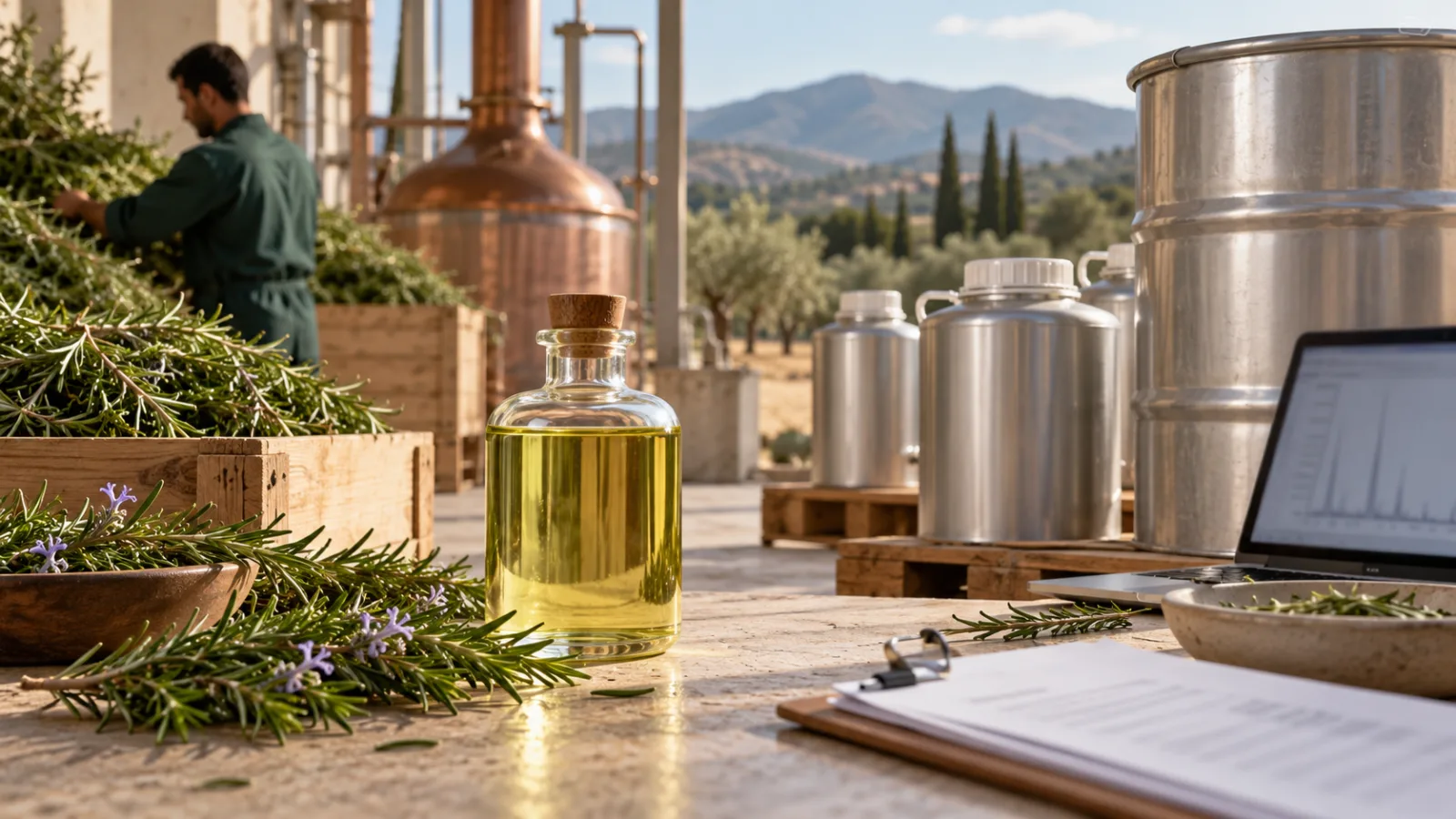
Rosemary Oil Wholesale: How to Choose a Bulk Rosemary Essential Oil Supplier
Buying rosemary oil wholesale? How to choose a bulk rosemary essential oil supplier: specifications, batch documents, packaging, MOQ and log…
Read article
Rosemary essential oil is not a single product. Buyers in France, in particular, search by chemotype: “romarin à cinéole”, “à camphre” or “à verbénone”. For brands and manufacturers, cineole-type rosemary essential oil in bulk is the most widely traded profile, and Morocco is one of its best-known origins.
A chemotype describes the dominant chemical profile of an oil within the same botanical species, Salvia rosmarinus (formerly Rosmarinus officinalis). In a cineole-type oil, 1,8-cineole is the leading constituent, giving a fresh, clear, slightly camphoraceous scent. The camphor type, often associated with Spain, and the verbenone type, often associated with Corsica, have different profiles and uses.
Rosemary oils from North Africa, including Morocco and Tunisia, are generally of the cineole type. The international standard for rosemary oil, ISO 1342, describes separate composition profiles for the Spanish type and for the Moroccan and Tunisian type. Buyers can use this standard as a reference when writing their own specification, together with a GC/MS analysis of each batch.
Cineole-type rosemary oil is widely used in cosmetics such as hair care, shampoos and soaps, in fragrance compositions and in household products. As always, the use level in a finished product is set by the formulator and confirmed by the safety assessment. Claims about health effects do not belong in a technical purchase specification.
Rosemary is distilled from harvested plants, so availability follows the seasons. Share an annual forecast, agree on container formats and keep a retained sample of each approved batch. This makes reorders faster and protects the consistency of your finished products.
Neither is better in absolute terms. The right chemotype is the one that suits your fragrance, formula and safety assessment.
With a GC/MS analysis of the specific batch, compared against your specification and, if useful, against ISO 1342.
Yes, natural variation exists. That is why acceptance ranges and batch analyses matter more than a generic label.
Key takeaway: for bulk purchases, specify the chemotype, verify it batch by batch and choose an origin, such as Morocco, that matches the profile you need.
When making a professional enquiry, include your company, application, target quantity, destination country and required documents. Explore the product range or contact Taramide to discuss availability and specifications.
Buying rosemary oil wholesale? How to choose a bulk rosemary essential oil supplier: specifications, batch documents, packaging, MOQ and log…
Read articleSourcing bulk rosemary essential oil for a hair oil brand: specification, consistency between batches, claims compliance, documents and scal…
Read articleEssential oils wholesale for UK buyers: why buy direct from a Moroccan producer, which documents to request, UK REACH, customs and logistics…
Read article